LED ZEPPELIN - WHATS YOUR FAVOURITE FESTIVAL APPEARANCE?

'I told Pagey one or two people would be here, but he said he doubted that very much' Robert Plant, Knebworth August 4th 1979 ...

Friday, 21 April 2017

LED ZEPPELIN - WHOLE LOTTA LOVE

"Gonna give you every inch of my love...."

THE moment when Led Zeppelin overwhelmed everybody and everything. Completely on the money, as perfect yet unique as could be. When the 'New Yardbirds' burst onto the scene in that hazy late summer of 1968, they took everyone by surprise. The two relatively unknown members brought into the spotlight by Jimmy Page and John Paul Jones helped create the thunderstorm that was Led Zeppelin. Onstage their reputation grew fast, the freedom and improvisations satisfying, rewarding and within months the stuff of legend. 

The debut album set out their stall, a wonderful hybrid of light and shade, defying the critics and delighting the growing legions of fans. Onstage, cover versions and improvisations shifted towards a darker, thicker sound. Groinal, filtering and renewing the salacious blues grind of their early heroes - Robert Johnson, Muddy Waters, Little Walter, Howlin' Wolf et al - with the lust and hysteria of youth and adrenaline. The early live arrangement of Garnet Mimms 'As Long As I Have You', with it's myriad of directions and moods and cover tunes, pivoted on a stun gun rhythm, an irresistible strut. 'Killing Floor' was another sexually charged monster, mixing Howlin' Wolf's dangerously predatory growl with the guitar flash of Hendrix, aided by a rhythm section that was so potent, fluid and telepathically syncopated.


But Led Zeppelin needed a song of their own, a clarion call to make venue's shake, to frighten and delight in equal measure. Buoyed by their meteoric rise on the first North American trek, work on II began throughout the spring as they fulfilled small UK dates, a return to Scandinavia and assorted media dalliances. 

Having rehearsed and routined at Jimmy's Thames side house in Pangbourne, the first serious studio time spent on the second elpee began on April 19th 1969 at Olympic Studios, when they would have a couple of days to record in earnest. 


The remarkable mixdown sessions 'released' on the 'Studio Magick' bootleg box set give us an amazing insight into the recording and performing process.

And the result is spectacular, revolutionary. Apart from kicking off the elpee in such fashion, Whole Lotta Love ushered in a thicker, darker, heavier sound and groove. 


From Robert's nervous cough to Jimmy's deceptively deft riff it immediately swings and struts. Once Jonesy adds unison bass figures it now has a throbbing undercurrent, a grind. Robert's voice - he once opined he got it 'in one take, I was right on the money there' - is frightening. Just about in control but on the edge of hysteria every second, it's incredible to think this is the voice of a 20 year old from West Bromwich. And just when the tension, the charge, gets too much in roars Bonzo. Solid, powerful, and once again right on the money. 


Lyrically Robert has lifted much from Willie Dixon's 'You Need Love', in particular Muddy Waters version. For many years a bone of contention over composition, it took an out of court settlement in 1985 to resolve the issue, leading to Dixon's name being added to the songwriting credits from that day forward. Steve Marriott also recorded a version 'You Need Loving' in '66 with the Small Faces which is very similar to Robert's vocal delivery. Strangely, the lawyers haven't been as vociferous in chasing a credit and royalties as with Zeppelin...

So by the time we hit the chorus Jimmy adds another sprinkle of magic - backward echo. Adding a backward slide crunch that swoops across the speakers and elevates the sound, the groove and the mood. And instead of a bridge, a different riff or a change of pace we get the now famous 'white noise' section. Beginning quietly with Bonzo's understated yet insistent counter rhythms, the sound opens up to a maelstrom of psychedelic wonder. Theremin blats, swoops and sirens meet orgasmic moans in a stereo panning frenzy that ebbs and flows always, always on the edge of madness but always, always under control. Genius. 

After the final sonic roar Bonzo underpins the storm and clears the air with a classic, powerful figure that introduces Jimmy's solo. And it's THE classic Rock solo - '58 Les Paul through a cranked Marshall with the extra cutting edge of the wah wah pedal set as a tone control. 6 licks, 6 figures, including that outrageous bend on the fourth. Then Bonzo steadies the troops back to that swaggering riff and everyone's dancing again. Then, the last cherry on the cake. Robert's 'way down inside' sketch. The primal sexuality, aided with other vocal takes and echoed nuances floating ghost like in the background, hits you right between the eyes as his lustful 'Looooooovvveeeeeee...' fanfares in the coda. You get the feeling it went on forever, the riff, the shuffle, the groove. Bonzo flexes his muscles, Robert pleads that he wants to be your 'back door man' and Jimmy and Jonesy plunder that groove.

And rest. It's the most remarkable song. Everything is right. The arrangement, the idea, hell the audacity of it is nothing short of revolutionary. To give some kind of context, Hendrix may well have changed the rules two years before but the accepted giants of rock weren't in place then. While Led Zeppelin were changing the face of music in Barnes radios in the UK were playing current #1 'The Israelites', and whilst 'Pinball Wizard' and 'Heard It Through The Grapevine' were high in the top 10, easy listening and pop was overwhelmingly the soundtrack for the nation. And Cream may have been #1 LP, but Zeppelin's debut was at #12 amid soundtracks and pop. Rock was coming, no doubt about it, but this was something else. 

For me not only is the song and the arrangement perfect, but Jimmy's production is nothing short of incredible. The sound on II is right on the edge of overload. That crunch, that punch and the way he captures the balance of light and shade. Pressed to the highest standard possible at the time, it's LOUD. And the uncanny knack of bringing the power to the fore while still maintaining the subtle nuances is wonderful. 

Five days after laying down the foundations of Whole Lotta Love Led Zeppelin were in San Francisco for a 4 night stint to open their second North American Tour. II was still 6 months away from release and the live set was still based around the 1st LP and various covers and improvisations. The earliest live sighting of Whole Lotta Love we have is the 3rd night in 'Frisco at Winterland Arena, where it's played as a solid, steady encore with more guitar white noise than Theremin in the middle of a compact arrangement. It's obviously not settled as a live song yet as the next captured live version - at Merriweather Post Pavilion on May 25th - shows clearly. 

On their return to the UK they feature it on their June 24th John Peel Top Gear session. And what a version. More hysterical and rushed, the subtleties of Jimmy's riff are ignored as they charge ahead. The mid section is nothing short of madness with Robert adding hints of 'Mystery Train' before a longer (8 licks) solo that threatens to go right over the edge with some outrageous wah wah figures. The coda has Robert noting he's 'got those West Bromwich blues', something John Peel remarked on during the original broadcast!

As for live, it - alongside most of II - was absent for much of 1969. Touring meant promoting and playing the record that was out, that the fans could buy and enjoy. Whole Lotta Love was the (near) future. The only other sighting is in the remarkable Ecole Centrale Paris show on December 6th where it's jammed as part of the How Many More Times finale. From the opening 1970 shows it's an encore - of course we all know the Royal Albert Hall version on 'DVD' - up to and including another breakthrough performance at Bath on June 28th. From then on it displaced How Many More Times as the conduit for the now legendary medley that closed the show. 

And that's how it stayed until the final show on the 1973 European Tour in Paris on April 2nd. During that time the mid section would change night after night but was almost always a frenzy of Theremin hysteria, clouds of guitar and vocal gymnastics over that faultless, flexible rhythm section. During the summer of '72 there was the germ of a powerful riff section that blossomed in Japan to include Everybody Needs Somebody To Love that stayed until that Paris show. Some of the most remarkable live versions are from those European dates.  

In May '73 the 9th US Tour saw a change in dynamics within the set. Visual effects were added and the set was more regimental - set list wise anyway - than before. Whole Lotta Love still closed the show, intro'd by Bonzo with a syncopated drum link that replaced the final verse of Heartbreaker to cue straight into the opening riff - but the medley was generally honed down to just the initial 'Boogie Chillun' sketch. Of course, Zeppelin being Zeppelin there were several nights when things got extended on those (numerous) great nights when they just soared. 

1975 saw it almost put out to grass, with just the initial riff and a few throwaway vocal lines as an introduction to the main encore Black Dog. As the tour progressed some funk came in  - Nassau Feb 13th is the first bootlegged night if I recall - and before long The Crunge, some James Brown and the trusty, lusty Theremin too. In 1977 it was even more brief, thrown in as a tease before Rock And Roll from the 2nd leg on.

The renewal in Copenhagen and Stevenage saw a brand new Whole Lotta Love. No Theremin or funk episodes, but a solid hard rock muscular set of riffs that Robert ad libbed over. Again the final 1980 shows saw 7 appearances as final encore, and indeed the last ever gig in Berlin features a brilliant experimental jam, and one of the longest versions ever. If earlier shows on the tour had some nostalgic Boogie, this was white noise, counter rhythms and a definite look to the future.

Played at all 3 reunions, it has remained part of Robert's solo shows in various guises and was part of both Page & Plant tours with nigh on 160 performances by the duo. My favourite was St Austell in '95 when it was a devastating stand alone set opener....

Of course it was a US single, in edited form and very much against the group's wishes. It hit #4 and was a big hit across Europe, particularly in Germany and Holland. In the UK Atlantic exec Phil Carson defied Peter and went ahead with preparing a UK release. It got as far as promo copies being pressed - and even a few stock copies escaped too - before it was unceremoniously stopped. Those copies - 500 is the legendary figure oft quoted - are now among THE top collectable Zeppelin items. 

There are dozens of Worldwide pressings on singles, EP's and promo's. It appears on several compilation albums too. And there are countless cover versions. But all that's another story....

This is about the song, the recording and the history of performance by Led Zeppelin. One of not only their finest moments, but one of THE finest moments in popular music. Ageless, timeless, revolutionary, perfect. Now go and play II and tell me it's 51 years old...!!


Tuesday, 7 March 2017

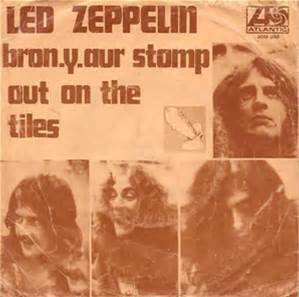
LED ZEPPELIN - BRON-Y-AUR & BRON-Y-AUR STOMP

 'Ain't no companion like a blue eyed Merle'

The Welsh period. After the mayhem of 5 US Tours and the media scrum following the success of 'Led Zeppelin II', they needed to rest and reflect. Robert recalled a place from his youth, Bron-Y-Aur, a cottage, where he and Jimmy could both relax and work, to see if they could write in the simplest, purest way. 

A sideways move, some hankering for Whole Lotta Love parts 2,3 & 4 would call it a backwards move. In hindsight for us fans and observers, a masterstroke.
The instrumental 'Bron-Y-Aur' was conceived at the cottage for sure, and recorded at Island Studios, probably in early July 1970 alongside Gallows Pole. A haunting and evocative instrumental, Jimmy weaves two acoustic guitars together to create a wonderful sonic landscape. The mix, with slight phasing between the two channels, adds an ambience for sure. A reflective aural tribute to the cottage that made Led Zeppelin take a left turn and helped secure a wide open musical future.
The various convoluted rehearsal tapes from this period include snippits and takes of Jimmy contructing this instrumental during May and early June.
Come the 6th US Tour it was included as part of a brief acoustic interlude, alongside 'That's The Way', and there are 8 recorded bootleg tapes to attest. The most famous is the 'Live On Blueberry Hill' L A Forum September 4th show where Robert talks at length by way of introduction, explaining the translation for the Welsh name is 'Golden Breast'. Never as evocative as the studio version, it was never played onstage again.
In contrast 'Bron-Y-Aur Stomp' is an uplifting celebration of good times around the hearth, flagons of cider and mead and the odd herbal cigarette. With backing vocals and assorted Bonzo percussion it's a joyous song that takes you into the Welsh mountains.


Robert at Jennings Farm


Months earlier, on December 13th 1969 Led Zeppelin laid down a rollicking electric backing track in Olympic No 2 provisionally titled 'Jennings Farm Blues'. A Riff Jimmy was fascinated enough with to obsessively repeat until exhaustion, and once the backing track was as he wanted it was time to add layers of overdubbed guitars weaving in and around the main theme. This was heady and electric but ultimately unfinished. 

Named after Robert's farm property at the time, it curiously is an instrumental with Jimmy grabbing the moment and adding stream of interweaving electric overdubs. 

We have several rehearsal attempts, and the final run through where those guitar overdubs are employed to magical effect. A Bootleg favourite for over 20 years, an official version finally appeared on the companion disc of Coda. 

By the time 'III' was being assembled the picking country riff was recorded as an acoustic hoedown, Robert dedicating it to his 'blue eyed merle' Stryder.

Live, Jimmy teased the riff during intro's to That's The Way in Japan 1971, but it was only formally added to the acoustic set for the 8th US Tour in 1972. 

Played pretty straight, it was a Robert Plant communion number nonetheless. 11 versions exist from that tour. For Japan '72 and Britain/Europe '72 and '73 it was the only acoustic piece, possibly designed to loosen the atmosphere and lighten the mood.


Not seen again until Earls' Court it was more relaxed and expanded with Bonzo adding spoons to great effect. 

It then became the finale of the long Magick 11th US Tour acoustic interlude, by now extended to include long solo indulgencies by Jimmy and occasional stand-up Bass figures by John Paul Jones. Even Mac The Knife got a look in at one point!
There are a handful of singles from around the world with this on the b-side, and a plethora of Polish Postcard Flexi's too

Spelling wise, there has always been confusion about it being bron-y-aur or bron-yr-aur. The band spell it without the 'r', official Welsh sites with. Go figure. Various releases of both songs over the years have used both spellings. 

A memory of happy carefree times for band and fans alike.

Sunday, 5 March 2017

LED ZEPPELIN - STAIRWAY TO HEAVEN


It's almost beyond comprehension that Stairway To Heaven is more than 48 years old. Like so many of us of a certain age, from a particular era, I can't quite pinpoint the time I first heard it, or more to the point the moment when the enormity and significance became clear. It comes from a time of great positivity, when artists could truly express themselves, be courageous and daring, when THEY were the most important thing in the business. The very fact Led Zeppelin got their way with an LP with no name, no title, no hint, no branding as it would be today, bears strong testament to that. 

But what brought Led Zeppelin to this point, this zenith of creativity? For that we need to go back to their birth, the inception of Jimmy's dream, his master plan. Even before they'd played a note, hell, even before the band was assembled he had THE grand vision. He spoke about deciding whether to pursue a hard, blues based direction or a soft, West Coast influenced way citing The Incredible String Band and their ilk by way of example. Choosing the more bombastic, direct style was ultimately the perfect choice. 

From the moment a shy Robert Plant shuffled nervously into Jimmy's World in Pangbourne and contemplated the suggestion of Babe I'm Gonna Leave You with its' light and shade blueprint and endless procreated possibilities and adventures, Jimmy knew if he chose wisely and that his new buddies were as capable as he hoped, then he could have both. 

Despite the dazzling array of styles and moods prevalent on 'Led Zeppelin', when it came to their onstage direction it was certainly a case of power, bombast and every inch of their love. Creating a storm and fearsome reputation left little room and onstage time for subtleties aside from the light and shade dictum played with and stretched during improvised moments. It was really with 'II' that their songwriting and musical prowess came to the fore. What Is And What Should Never Be, Thank You and Ramble On already showed the speed with which Led Zeppelin were evolving. 

By 'III' Jimmy knew the sky (and beyond) was indeed the limit. He has always said that each LP was a signpost, an indication of where they were at that particular time, and on 'III' we heard an amazing maturity and confidence, a bright shining sound, more focused than before and more accomplished too. This wasn't a band dazzled by their success, nor one under enormous record company pressure to deliver the 'son of Whole Lotta Love' or Zeppelin II part II. This was four extremely talented and confident musicians with a free rein who went their own way into the unknown. Robert's lyrics were becoming more confident and distinct. Bonzo and Jonesy had that incredible empathy and syncopation most bands dream of down to a tee and Jimmy was weaving textures, moods and the guitar army as he really began casting his spell.

The confidence and quiet assurance of the songs on III is very noticeable. Jimmy is bringing the guitar army into the frame with some wonderfully understated and lyrical overdubs and textures on Celebration Day, pieced together like an aural jigsaw. The solo itself leans towards his muse on Stairway, very lyrical if much more succinct. Two sides of Robert's growing lyricism stand out too, the thunderous tale of Immigrant Song which is juxtaposed by the simple yet beautiful innocence of That's The Way. And if the swagger of Out On The Tiles shows the latent power of Zeppelin is always there, Gallows Pole is almost a mini blueprint for the idea of Stairway forming in Jimmy's musical mind. Both Bonzo and Jonesy are outstanding, effortlessly managing to drive Robert's tale of impending doom with a muscular and melodic swagger and at the same time sounding near hysterical and completely in control. Less is more, even as it soars into the distance.

After the 6th US Tour the immediate response to III by a largely surly and negative press led to Jimmy pushing Led Zeppelin harder than ever. The remarkable fragments of rehearsal tapes from Headley Grange show a band working hard, enjoying every moment and high on confidence. Amid the new ideas - electric, acoustic, eclectic and traditional - came a lovely studied acoustic theme. Traditional, even centuries old (Spirit's ambulance chasing lawyers should be ashamed...) it was certainly different. Listening now, there's a relaxed beauty, a studied calm that pervades the introduction. Jonesy's ear for harmony shines with his double recorder melody before the tone is set for Robert.

His vocals are sublime, nervous and innocent, almost hushed. The theme and expectation is almost overwhelming, and one of Led Zeppelin's greatest strengths makes it so. As Jonesy once said 'listen to a song and it tells you what to do'. They resist the temptation to overplay or to rush. Their green light to make music without outside pressure certainly helped, and Jimmy let the music flow. Over the 8 minutes they created a masterpiece. An anthem for the ages. Lyrically it has all the innocence and optimism a 22 year old could gather, and as the song hits its' stride you can hear Robert's confidence and pride growing line by line. Again, Jimmy brings the guitar army into play with a subtle but perfect mix of electric and acoustic, 6 and 12 string themes and chimes.

By the time Bonzo enters it's almost a relief and the expectation changes to smiles as the journey gets into gear. Robert once said he felt something 'almost unnatural' was pushing his pen in front of that roaring fire in Headley Grange. It does almost seem too natural the way the song takes on a life and mind of it's own as it strives forward, grows and expands. By the time we reach the fanfare pause, the song has taken on a whole new feel and you hold your breath in anticipation of what your brain tells you is coming next. 

The A to G to F sequence is rolling, positive and full of smiles. Then Jimmy get's into THAT solo. It's almost too perfect. Over the years and decades it's been analysed, studied, annotated, criticized and much much more. Compared to the dazzling and frenetic guitar athletes that have grown up in the wake of the greats - Hendrix, Beck, Clapton, Green, Gibbons, Guy, Les Paul, Allman etc  - it's been to my mind unfairly derided. For me the mood, the feel, the style is so important. It's full of emotion, something Jimmy is particular keen on dealing in. It works so so well and his added harmony slides are the icing on the cake. 

The final verse, with Robert at full throttle and Bonzo powerful yet completely controlled, is again something else. As the new companion disc mix shows, Jimmy layers guitar upon guitar building towards the inevitable climax, brilliantly underplayed with just Robert once again nervously whispering the final words. Alone. Perfect.

As Robert's final words fade, we're left with that silent resonance, that feeling of wow. It doesn't fade out, it has a definite length and sense of complete structure and composition. The decision of track order on the fourth elpee is bold yet to me perfect. Side one seems giant, almost an untouchable monolith of power and groove. The way the tracks and mood unfold is stunning, and to end that with Stairway is almost too much to take! 

Sadly side two is overlooked, yet in hindsight you can see so much that makes the LP complete and the landmark it truly was and is. The variety and widescreen confidence of Led Zeppelin as 1971 unfolded is truly something to behold. All of the 8 released tracks would be performed live by the band, some much more successfully than others it has to be said! For me it's fitting that the track order gives us two sides of remarkable music, with the second side taking us from the optimistic strut of Misty Mountain Hop through to the delicious groove of Levee. But enough of the rest of the elpee, you'll find my words and thoughts on those elsewhere. This is all about one song, for many THE song.

Once recorded, Peter and the band resisted the avalanche of demands to release a single, an edited one at that. As with Whole Lotta Love the answer was the same - you want the track, you buy the album. Simple. It's not a teaser, a leading track. However great we think it is, however big it's become, it is still part of a much bigger thing. The record, the momentum, the continual maturing and development of Led Zeppelin. Another milestone along the way for the greatest band of them all, rewriting musical history and expanding the boundaries as they went. The doors of perception were truly blown off. 

And now we come to what happens next. As THE track picked and played by FM stations across the globe, it simply had to be performed live. This was a big challenge. The studio version was (and is) unique, meaning a live arrangement had to be thought out, flushed out and rocked out. The first thought was Jimmy's guitar. Obviously to be performed on electric guitar onstage, he thought of the then defunct Gibson 6 & 12 string twin neck guitar, favoured by blues and country players in the 50's and 60's but long out of production. He contacted Gibson and they recommissioned it, presenting him with a cherry red model, serial number 911117. It was to breathe life into the song (and others) onstage. 

After intense rehearsals, STH was introduced into the set for the 'Return To The Clubs' Tour. It was first heard at Belfast's Ulster Hall on March 5th 1971. Thankfully we have a recording of this show, where 3 other tracks are also previewed. STH is tentative with some lyric anomalies but already a monster live song. It would still be 8 months before the studio version would be released and live it was initially greeted with an expectant hush. For these 14 shows it was placed 5th in the set, after initial blast of Immigrant Song/Heartbreaker, the intense blues of Since I've Been Loving you and the new strident syncopation of Black Dog. We only have 3 recordings from the tour, the most famous the BBC live set from April 1st where it sounds really fragile and intimate. You can hear every tiny nuance of Jimmy's playing, even the switching of necks when the 12" string first rings out.

It would become a set staple from that first performance on, performed at every complete show over the next 9 years. Like the 'Clubs' Tour, we have very little aural evidence of the summer European gigs. In fact, we only have compelling evidence of 6 gigs and only 2 bootlegs plus a fragment of a 3rd, the infamous Milan Riot show. For these gigs Stairway was moved back in the set, now to be performed an hour or so in, after the initial burst and a by now up to 30 minute Dazed And Confused. The 7th North American tour saw it becoming a live tour de force, more confident night after night with Robert comfortably adding his first vocal ad libs and Jimmy extending the solo gig by gig. Audience reaction was already building, possibly thanks to press reports and even bootlegs of the BBC show trading among the faithful before Zeppelin hit your town. Celebration Day would follow, meaning Jimmy would not have to change guitars and play it on the twin neck too before they sat down for a long acoustic set. The last recorded show on the tour - captured brilliantly on the legendary 'Going To California' bootleg - includes a wonderful Stairway, still a couple of months from release but sounding more and more like one of THE set highlights.

Through the Japanese Tour it was a highlight, and even more so along the winter UK shows where it was played for the first time to audiences that actually heard and more than likely owned the record! Once again it was extended, Jimmy's solo beginning to twist and turn more, and it maintained it's position in the middle of a set that was juggled a fair bit as they strode around the country. In Australia it really was a revelation, with the already ecstatic audiences treated to wonderfully evocative performances. Interestingly, Robert's throat problems saw the final verse sung in a lower register on more than one occasion. 

The summer of '72 was when Zeppelin hit an incredible height as a live attraction with some long, unique performances. Of course, we have How The West Was Won as testament to that time, and as with most of the shows Stairway was an absolute killer. By the 2nd Japanese dates it was moved to penultimate place in the set as the arrangement was stretched to allow Jimmy even more room to change mood and momentum in the solo. The real peak as a live number would ultimately be the 1973 US 'two tours' as Robert put it. Elevated to an anthem by fans and FM Radio across the States, it was a moment of high drama complete with extended solo that included a 'tango' section for Jimmy to pour out an endless solo and countless vocal ad libs punctuating the lyrics 20,000+ would sing by heart night after night. Even Robert's tambourine sketch was now de rigeur!

After that the weight of the show would sometimes fall on Stairway. As superstars with huge stadiums full of adoring fans it was now the climax of a 2 1/2 hour plus spectacular. Some nights it saved the show. Others it elevated the show even higher. Despite the pressure of expectation it was usually a joyous, uplifting part of the set. But, as time the wheel rolled on it became a bit of a millstone for Robert in particular. 

In 1977 on a good night it was spectacular. If the show was great it could once again be even greater, but on a poor night it was perfunctory, tired even. 


The final shows in '79 and '80 ranged from a low ebb for the song to somewhat of a renaissance and Jimmy in particular is relishing the challenge to end the new slimline set with wonderfully constructed, dramatic solo's at some of the final shows including Hannover, Zurich, Frankfurt and Mannheim, even if the final performance in Berlin is less dramatic than those that have gone before and is more jazzy and calm. 


Post Zeppelin it was and is obviously a song Jimmy would want to play and proudly celebrate, but not Robert. It was in September '83, on the 20th & 21st that Jimmy would close his short 20 minute slot at the ARMS benefit shows at the Royal Albert Hall with an emotional instrumental performance. Nervous and 3 years off the road, it was rusty but ultimately uplifting and inspiring. On the second night Clapton & Beck added to the fun, backing Jimmy's solo. For the 9 ARMS US shows it grew longer and was the unofficial climax to the shows. 

In '88 Jimmy revived the instrumental arrangement and Stairway was the final encore on all the Outrider tour dates. The 5 shows I saw were all excellent and Jimmy was much more confident and proficient too, making the final song of the night both an emotional and musical highlight.

The next performance would be the most bizarre. On November 10th '94 Jimmy & Robert appeared on Japanese TV and performed a truncated acoustic version, very delicately and reverential. 

And, of course, the 3 main 'reunion' performances would all feature the song. Live Aid, Atlantic's 40th Birthday and the Ahmet Ertegun tribute, where it was now in the middle part of the set and performed the closest to the original studio version as it ever was. 

Stairway To Heaven is a triumph. A song I've loved for a long time, now an old and cherished friend. A milestone in popular music, and one of the pieces of original music that helps to elevate Led Zeppelin up to the status they so richly deserve to hold to this day. A great source of pride for Jimmy Page in particular, it does everything just right. At 8 minutes it has no fat, no flannel. 

Of course, the calls from Atlantic to release it as a single, to have an edited version for radio, were deafening. And ignored. Quite rightly so. It has of course snuck out in a few versions. In Australia we had the 'Acoustically' 3 track 7" EP. There was a US Promo mono/stereo 7" in a cloth bag. This was also bootlegged on green vinyl, and there's a 7" picture disc (2 versions, one with 2 different pictures, the other with the same 1977 live shot) with Hey Hey What Can I Do on the flip. In The Philippines it was issued as a promo 7" spread over the two sides! South Africa issued a promo 7" of the full version with Going To California on the flip. 'Little LP's' also produced a 3 track 7" with a reduced version of the album artwork where it sits along with Rock And Roll and Black Dog.

When Remasters came out it's featured on the 4 track long box CD promo, the lovely 10" vinyl promo and there's a US 'pop up' CD + 7" that opens up to reveal the lyrics and the old man with the sticks and a zeppelin origami style. There's the 2 versions of the UK 'Jukebox' 7" where it's coupled with Whole Lotta Love. The rare promo comes with a record company letter and the easier to find centre punched issue. 

Classic Records pressed a 1-sided 'test' 12" to go with a box set of the first 4 elpees, there's a Brazilian and Venezualen 12" with some strange edits and occasional 'test tone'. Russia and Poland have issued postcards with the opening 3 or so minutes on too. And so it goes on. Of course we have officially 3 live versions on audio (4 including the O2) and 3 on film. Unofficially on film there are numerous cine clips as early as LA Forum 22/8/71, Houston 25/8/71, San Bernardino 22/6/72 and the middle night of the movie at The Garden on July 28th. From then on cine film is much more common if still fragmentary and usually silent with dubbed sound. We do have moments or more of Stairway To Heaven from the following 1975 shows - Dallas 4/3, Seattle 17/3, Seattle 21/3 and all 3 LA Forum shows 24, 25 & 27/3. There are the last 2 Earls' Court performances pro shot, the 25/5 show on the official 2DVD. 

Come 1977, there's footage from Madison Square 14/6, LA Forum 23/6 and the Pro-shot Seattle 17/7. From '79 we have both Knebworth shows pro-shot, and from the final Over Europe '80 trek cine from Cologne 18/6, Rotterdam 21/6 and Munich 5/7. Doubtless there is more both audience and pro shot......

So there we have it. Now, go and dig out Atlantic/Polydor LP 2401 012 in whatever incarnation you have it and play side 1 , track 4. 


Tuesday, 8 November 2016

THE 4TH ALBUM - CRAFTED TO PERFECTION. AND WHAT IF IT HAD BEEN 4 EP'S?¬


It seems almost beyond comprehension that Led Zeppelin's 4th elpee was released 49 years ago. The importance of such a landmark collection of songs and recordings is too so far reaching and significant that it's safe to say Rock Music as we know it would be very different without this music and the impact it has had over the years and decades.

It is, of course, Led Zeppelin's most famous work for a variety of reasons, but to the layman, the occasional fan, the curious listener, it has reached this peak of consciousness because of one particular reason - Stairway To Heaven. Worshipped, reviled, dissected, praised and blamed in pretty much equal measure at one time or another, it's been held up as the saviour of the western World on one hand and an accursed over long muse almost directly responsible for the 'saviours' of the Punk Scene to rise up, out of tune guitars in hand, and rescue comatose teenagers and save them from a life of simple, peaceful hippydom on the other. 


But, there is SO much more to this record, this period, than one song could ever say, mean or signify. After III was almost universally lambasted by an uncaring, knife sharpened press waiting for what they saw as a wounded Gazelle ripe for slaughter at their slavering hands, By the time those barbed words were fish n chip paper, Led Zeppelin were already moving on. Rehearsal and recording sessions had already begun whilst Atlantic were promoting the follow up to Led Zeppelin II and fending off questions about the next gigs and plans.

These are just my observations, my thoughts. Frankly, you could easily write a book about the record (one or two already have to be fair), so this isn't my time or place for a historical, factual dissection. let's open this up, fitting alongside the widescreen masterpiece that this record indeed is. 


In contrast to the speed that music is composed and released now (and has been for a couple of decades at least to be honest) Led Zeppelin wrote and performed at a ridiculously prolific rate, and to an ever higher standard. 18 or so tracks were auditioned and tested for III, 10 (plus the only non-elpee track of course) making the final cut. With the 4th elpee we have 11 (known) finished tracks and a plethora of ideas, riffs, curiosities and snippets that would be distilled and eventually bloom over the next 8 sides of studio wax Led Zeppelin would release over the next 5 years. 

Anyway, the best 8 songs were chosen, perfected and presented. And their growing compositional maturity was shining through. Only 1 track leaned back, and let's face it the complete overhaul in just about every term (lyrics aside) from Memphis Minnie in 1927 to Led Zeppelin 44 years later could not be more striking. And the depth of songwriting is only one key ingredient. The performances are astonishing. 


Robert reaches his highest, dizzy wail in Misty Mountain Hop, perfects his Golden God meets Howling Wolf Strut in Black Dog, and soars over the most potent band in the World with his primevil wail in Rock And Roll. And, to the shock of those who didn't really listen to III and ignored the whisper side of their light and shade doctrine, he proved to be a damn fine singer whether he's missing the West Coast, duetting with Sandy Denny or majestically adding a dimension to Jimmy's guitar symphony before he climbs the Stairway.

Jimmy too, sounds so confident, so at one with his playing. Black Dog not only boasts a masterful solo, both edgy and lyrical, crazed and controlled, but some fine harmony dynamics and layers of sonic textures. Wakey wakey, rise and shine, the Guitar Army is on the march! It's gorgeous to hear the sudden speaker slashes in Rock And Roll, the delicate harmonies in Misty Mountain Hop. The slide and phased swathes of insistent, relentless riffs rise and rise like the flood waters themselves in Levee, bringing the chaos, panic and confusion to life as his brilliant production swirls everything around Roberts moaning cadence. Genius.

Acoustically, Jimmy really comes to his own on these tracks. Beautifully lyrical, with a great empathy for the song and the mood. The mandolin work is striking, perfectly fitting and quintessentially English, the perfect backdrop for Robert and Sandy's playlet. And it ALL comes together on Stairway To Heaven. From the bucolic, cautious themes, gradually yet deliberately adding layer on layer of guitars, each adding without swamping or cluttering the sound and themes. And then the fanfare. And THAT solo, complete with the perfect sympathetic harmonies at just the right moment before a climax like no other. 

John Paul also brings so much to the table at these sessions. It was after all his muse, his humour and ability, that brought us Black Dog. He underpins Rock And Roll perfectly, provides a two pronged swing to The Hop. Four Stick features some new age sounding Synth work too, played with a careful session man's precision and ear for melody and arrangement. The recorders on Stairway, and his bass playing throughout, are perfect. One very important point to me is the space, the open sound, the way the songs breathe. Every note has to be right, has to mean something, to be there for a reason. And it all is. 


And Bonzo. Much is made of the sound of the stairwell, the crunch. But the real key is his groove, his swing, his heart. No one could possibly sit still when Rock And Roll kicks in. Who doesn't 'air drum'to THAT snare roll as The Hop winds up to head for the Misty Mountain? And the forward thinking, why can't I damn near genius of doubling up his sticks to bring life to the turnaround riff of Four Sticks and take it somewhere no one would have thought of or deemed possible. And then there's Levee. THE most potent sex groove, swinging like no other, oozing power but with perfect almost clinical restraint. Add Jimmy's groundbreaking production to some unholy drum fills and you've brought side two to a climax that comes close to the 'perfect' peak of side one. 

And what of the production? Dig out Master Of Reality, In Rock, Very Eavy, Very Umble. Compare them to this, they sound flat, dull and lifeless however good the music is. In fact, there's not much around today that can compete. Really. So far ahead of the game. Don't play the game, BE the game as Robert once mused. 

The sleeve is perfect too, mysterious, mischevious, symbolic,  odd and full of clues and talking points. And they got their way. The 'suicide album' is Led Zeppelin's commercial peak, and not only of theirs but one of music's too. 

So, here's a final muse. Originally there was a thought to release the songs on 4 EP's. Including the 3 known outtakes, how would you assemble the EP's? Taking one for each symbol, each member. My choice would be - 

Jimmy - Black Dog, Stairway

Robert - Battle Of Evermore, Going To California, Boogie With Stu

John Paul - Misty Mountain Hop, Night Flight, Down By The Seaside

Bonzo - Rock And Roll, Four Sticks, Levee

Ask me tomorrow, it'll be different!


Sunday, 30 October 2016

LED ZEPPELIN - OCTOBER 1970:TOP OF THE WORLD - PLATINUM DISCS, BIGGER THAN THE BEATLES, BOOTLEG CARNAGE

October 1970. A very important time for Led Zeppelin. Looking at it now, there were some incredible moments that were to not only show the progress and growth they had made in their first two years as a group, but also strongly indicate and foresee the events and amazing times to come over the next decade. And not just for them, but for the industry too.

So, just two years after completing the transition from the Yardbirds, from recording a remarkable debut elpee in the shortest time, from appearing at the bottom of the bill (sometimes without any billing) across the world, Led Zeppelin were 'Top Of The World'. Melody Maker's annual poll proclaimed 'Zeppelin Topple Beatles' on the front cover of the issue published the same day Zeppelin played two sets at New York's Madison Square Garden to complete their 6th and most successful US Tour, September 19th. 

With the release of the new record 'III' imminent, they had a moment or two to take stock. Not for them the merry go round of release a single, do some TV, release the album, tour. Then the same every year. Oh no, for Zeppelin, they never quite managed to get the put the album out, THEN tour on the back of it quite right. 


It was a time of constant movement. Perpetual motion. In such a short space of time they'd gone from being a joke to turning down incredible offers to play to larger and larger audiences. The hottest ticket. And just when the vast majority of bands would have coasted, taken the easy option and gone for the obvious, Led Zeppelin got to the junction and turned left. Into the unknown. 

Brave, confident, possibly stubborn. But incredibly important, possibly the most important left turn they or anyone else has made in the history of rock. Not since the Beatles quit live performances would such a far reaching musical decision be made. Led Zeppelin III was, as Robert observed at the time 'the most important album we've made, and probably will ever make'.

On record fans knew of 18 songs. Of these only Jimmy's showcase and the drama of Babe I'm Gonna Leave You from the debut and the strident whimsy of Ramble On on II would feature acoustic instruments. Of course there was much more light and shade on the majority of the fully electric tracks too, but the perception was electric = heavy and acoustic = soft. Onstage, even with less sophisticated sound systems than they would go on to use, the progression towards acoustic material was smoother and ongoing. 

White Summer/Black Mountain Side had been a staple part of the set but, like live versions of Babe I'm Gonna Leave You, was performed electrically. At Bath, and probably in Iceland the week before Led Zeppelin played acoustically for the first time onstage as they premiered That's The Way under the working title The Boy Next Door. 

By the time they returned to the US the confidence was there to add Jimmy's new albeit brief showcase Bron-Y-Aur instead of White Summer. Ironically, the last time that was played was by Jimmy on the Julie Felix show on April 26th for it's only acoustic outing. Save for a couple of partial improvised insertions in Dazed And Confused over the coming shows, White Summer would lay dormant for the next seven years.

The new songs for III had been mooted and toyed with as early as November 1969. The Hendrix style demo Jennings Farm Blues recorded at Olympic Studios that month would transform into the decidedly English and certainly more bucolic Bron-Y-Aur Stomp. 

Further songs were written and rehearsed in the pre-Bath visit to Snowdonia, then honed alongside more electric pieces later that month at Headley Grange. A fair amount of recording was done in late May and early June, the final sessions wrapped up immediately after Bath. But much more important even than the material, the writing process or style of the new songs was the maturing and evolution of Led Zeppelin. Published in December in Disc, John Paul Jones was interviewed during the Headley Grange sessions and noted "There's really no format, no set ideas...we're using acoustic things, rock things, strange timings...it's getting better - we're beginning to understand each other".

That alone says so much. Peter Grant's influence and foresight cannot be underestimated here. his complete control over all non music matters gave Led Zeppelin such confidence, breathing space and ability to focus they were able to evolve and mutate as fast and as far as they wanted. After 5 US Tours in 17 months the Welsh break and collaboration and the subsequent full band sessions was miraculous. And having the complete backing of Gee meant Atlantic would release III without questioning of approving any of the material. Led Zeppelin were in control and beginning to see a long future ahead, not just a quick burst that had been the trend for so many artists at the time. 

And in a nutshell, that was the genius of led Zeppelin coming to the fore in October 1970. On the 16th they were presented Gold and Platinum awards for sales of II and US sales of the Whole Lotta Love single released the previous December. In the UK II was still in the top 10 elpee charts, almost a year after its release. The media hype and talk about this huge 'heavy music group' was palpable, and advance sales of III added to the expectancy. As a result reviews were at best mixed and cautious, at worst hostile.

But Led Zeppelin didn't care. They knew. Audience responses to the new material - and lets face it there are only the final three songs on III that could be called truly 'acoustic' - was better than ever, and cloth eared reviews that didn't seem to appreciate Immigrant Song or Since I've Been Loving You truly weren't worth the bother. Even the sleeve got stick, sneery comments about it's 'pop' leanings were noted and dismissed. 

At the end of the day, the future was more important than the present. The giant step of highlighting some gentler, broader and differently intense songs and widening the sound - certainly brighter than the bottom heavy slightly overloaded crunch of II - was to yield dividends along the way. The aural palette cleansing was to subliminally prepare fans (and critics I guess) for the wonders of the fourth elpee. And, in true Led Zeppelin fashion, the next album was already under construction. Perpetual motion. Before the year was out they would have recorded some of their most important best and influential work. And the next time the World saw Led Zeppelin onstage a chunk of the new music was incorporated into the set with an average of only 3 or 4 songs off III in the set. III was a statement, as the sleeve notes at the time indicate, and that was it's most important function.

The left turn was right. At the right time, with no turning back. Led Zeppelin weren't controlled. They didn't implode, they didn't stagnate. When the World heard III back in October 1970 even those that predicted their demise would soon submit and admit they got it wrong. The seeds, and some of the songs recorded at the time, would come into the light over the next 5 years, some hidden for decades before blossoming. One of THE most important months in their history. 

And at the same time they publicly decried and temporarily halted or at least slowed down the new 'scourge' of the industry they ironically helped make popular - Bootlegging. The previous year Rock Bootlegs had come into being with Dylan's outtakes set The Great White Wonder. Very small time and cottage industry at the outset, Ken and Dub of the soon to be named Trade Mark Of Quality monicker had stumbled across a money making venture beyond their wildest imaginations.

A year later and the live Rock Bootleg had come to be. The Stones had LiveR Than You'll Ever Be as a superior alternative to their official Decca Ya Ya's platter, and the logistics of recording an artist in concert was so much easier than searching for unreleased studio tracks from the very small roster of artists considered worthy or worth Bootlegging at the time. So, in this climate Led Zeppelin were perfect. 

In the summer of 1970 Peter Grant had poured water into a VCR machine trying to film the Bath performance and complained about the 'professional looking' bootleggers in the audiences during the short string of German dates in July. When Melody Maker ran the 'Led Zeppelin Live LP' story in September, he naturally went berserk.  The story alleged that two bootlegs - one studio, one live' - were imminent and would be in the shops in days. Immediate denials were issued, stating that one was a German bootleg and 'several people are in custody awaiting trial' and Peter added that he thought there could be '...no tapes available'.

Whatever the real truth of the matter, the live set was more than likely Blueberry Hill. As for the 'studio' set, it's either a hoax or possibly Pb(more famously known as the reissue Mudslide) which is from a Radio Broadcast and could possibly be mistaken for studio material as it begins with the then unreleased We're Gonna Groove.

So, although Led Zeppelin claimed to have halted the spread of illegal recordings, it was only the tip of a very large iceberg, one that was to prove immovable and unstoppable over the years. The main reason is Led Zeppelin's unique performances, each of which is ripe for Bootleg. Different every night, unreleased original songs, cover versions, improvisations. Any one of those is reason enough. All together..... 

So there you have it. In October 1970 Led Zeppelin were Top of the World. Voted the best band, multi-platinum awards, their second elpee still riding high in the charts and sell out stadium tours at their beck and call. Peter would turn down a $1 million offer top play a new years TV show. They had the World in the palm of their hands. And they turned left. The rest is history. And look what happened next...