LED ZEPPELIN - WHATS YOUR FAVOURITE FESTIVAL APPEARANCE?

'I told Pagey one or two people would be here, but he said he doubted that very much' Robert Plant, Knebworth August 4th 1979 ...

Wednesday, 17 January 2018

LED ZEPPELIN - BLACK MOUNTAIN SIDE


'This leans towards the land of milk & honey, the East, 
and features on guitar Jimmy Page'
Robert Plant, Knebworth Festival, August 4th 1979

The first instrumental, one of only four across Led Zeppelin's arsenal. Brought by Jimmy from his Yardbirds days, a mood changer and designed to showcase Jimmy's acoustic prowess and ambitions. On 'Little Games', 'White Summer' was a more British, western conservative recording, despite being in nodal DADGAD tuning.

'Black Mountain Side' emerged as a short intermission, exotic rolling fingerpicking with the help of  Kenyan borm Indian Tabla player Viram Yasani. 

Basic instructure, following just a couple of themes, it strummed in beautifully over the fading 'Your Time Is Gonna Come', accentuating the light start to the second side of 'Led Zeppelin'. If nothing else, the sudden stop and lift off into 'Communication Breakdown' is a classic moment. Light and shade.


But one major point of controversy is who wrote it. Listed as a Jimmy Page composition, it leans very heavily on Bert Jansch's 'Black Water Side', from his 1966 elpee 'Jack Orion'. Here it was listed as 'traditional'. Anne Bredon/Briggs also performed it, as both 'Black Water Side' and 'Black Mountain Side'. In truth it's a traditional English Folk instrumental, handed down from one generation to the next. Jimmy laid claim to it, which stands to this day, probably due to the addition of table drums and slight arrangement changes.

Live, it took on another life entirely. Always performed inside 'White Summer' as a virtuoso showcase, it immediately stretched upwards of ten minutes and more onstage, usually with some explosive and inspired Bonzo percussion work.
Again a lack of 1968 recordings make it hard to say if it was included during the first Scandinavian shows, but the earliest live version captured - from Spokane on December 30th - is of 'White Summer' alone, complete with licks and references from another Bert Jansch track 'Casbah', an original Jansch composition from his eponymous 1965 debut.

The earliest recorded Led Zeppelin performance is from January 10th 1969, the second of four shows at Fillmore West. Here it's taking shape as the White Summer/Black Mountain Side medley that would extend, flourish and finally decay over the next 11 years.


We have 41 recorded live versions, stretching until the end of the 5th US Tour, the last being the final show at Phoenix, AZ on April 18th. Always performed on Jimmy's Danelectro, we also have the only acoustic performance some 8 days later when he appeared shyly  BBC TV's Julie Felix Show.

Retired from the set after that, save a couple of improvisations of the riff during 'Dazed And Confused' (Tulsa August 21st 1970 stands out), it was reprised in 1977 as an exotic introduction to the new set highpoint 'Kashmir'. Played every complete show on the tour, except in Tempe on July 20th where a spaced out Jimmy Page began 'Kashmir' suddenly and alone until the rest of the band joined in, it varied from a crowd baiting source of high drama to an overlong indulgence. 

'Swan Song' figures were introduced some nights, eventually becoming part of 'Midnight Moonlight' by the Firm, which itself blossomed from the embryonic 'Bird On A Wing' framework Jimmy had constructed for the ARMS US Tour with Paul Rodgers.

From then on it stayed, up until the final Led Zeppelin performance in Berlin. Despite being introduced by Jimmy as 'from the annals of Rock History', it's a sadly desperate and unsatisfactory version, lacking in cohesion and drama.

On film, we have two of the finest examples thankfully captured. The brilliant Royal Albert Hall version from 'DVD' is about as good as it gets, a ferocious Page/Bonham battle inside a truly virtuoso Jimmy Page performance. And, despite some damage, the legendary Julie Felix show acoustic take.
In 1977 there's a great cine clip from the final Chicago Stadium April 10th show where we see the end of the piece and the dramatic beginning of 'Kashmir'. No other clips show it apart from the pro shot Seattle 17th July footage. In 1979 we have the two Knebworth performances, but none of the 1980 cine films show any clips of any note.
Of course, being a short instrumental there are no single releases, but there are at least 2 different Polish Postcard Flexi singles.


Post Zeppelin, Jimmy inserted it into 'Midnight Moonlight' with The Firm (as he had done on the ARMS tour when it was 'Bird On A Wing), and again on the Outrider shows. 

It regained it's place as a lone piece for the Coverdale Page Japanese gigs, but was omitted from then on.


Tuesday, 9 January 2018

JIMMY PAGE - POWER, MYSTERY AND THE HAMMER OF THE GODS


JIMMY PAGE - A PERSONAL REFLECTION


Growing up, before the words Led Zeppelin meant anything to me, I loved music. 'Pop' singles came from my pocket money. By the time I was 13 I'd graduated to LP's, but before that it was 7" wax. All types, all styles. If I liked it, i'd try to buy it. For some of those songs there was something intangible, unique. Beyond the singalong, the chorus, the beat.

Tobacco Road, Baby Please Don't Go, With A Little Help From My Friends, Circles, Sunshine Superman, Out Of Time, The Crying Game..... 

So many to play and play and enjoy, to immerse myself in. Fast forward to when my Zeppelin hunger was insatiable and I learnt Jimmy Page played on those records, and hundreds more besides. 

Before my 14th I discovered Led Zeppelin. An 8 track of the first album, followed swiftly by the vinyl of II and within weeks, on my 14th, Physical Graffiti. I was hooked, And Jimmy Page was the centre of it all. As a teenager I marvelled at his playing and his band. Nothings changed...

It's always been a challenge putting what Jimmy means musically into words, how and why he to me is The Main Man. So, I'm going to offer some observations, thoughts, memories by way of explanation. 

Guitar playing is a consummate art, but to see the bigger picture is the real genius. Led Zeppelin afforded Jimmy the best and most unique vehicle possible. Complete expression fired up and embellished by 3 supremely talented musicians. They could do anything. And they did. 


From the opening blast of Good Times, Bad Times Led Zeppelin were unique. That thousand notes a second solo burst. Treating the guitar through a Leslie cabinet. The light touch and muse of Babe I'm Gonna Leave You, almost spanish over a light yet tense canvas before the descending riff and blast off. The searing dirty slide answering Robert's unbridled sex roar on You Shook Me and the sonic waves of harmonized power that dovetailed the menacing bow before the reprised Think About It dense flurry in Dazed And Confused. Almost half a century later, the first side of the first album still mesmerises. 

And that wonder, that groundbreaking bravery, has always been there. On May 18th 1985 The Firm played the NEC, Birmingham. Memorable for me as I sat in the side bar of the Metropole Hotel that afternoon with Jimmy taking and laughing. Also memorable for the fact Robert went, sat high up in the nosebleed seats and wept. Wept because he missed his mate, and because he saw and heard the beauty and unique genius of Jimmy Page. Tellingly Robert would opine 'I miss him furiously'. 

So many phenomenal recordings. We all have our favourites. Whole Lotta Love. A Wagnerian epic for a new age - the riff, the Theremin, that solo. And more than that, bringing incredible performances out of the guys. And then there's the production....

As Led Zeppelin ascended, their live performances became legendary. They not only changed the game, they WERE the game. And Jimmy was behind it all. His band, his design and his dream. The Royal Albert Hall film and the myriad of bootlegs give testimony to it all. Amazing times. And the bravery of Jimmy steering the boat away from the expected 'son of II' for the 3rd LP, and the wonderful music within. 

Then the masterpiece of 'IV', the breathtaking World Music of Houses Of The Holy..... It's more and more of an achievement every time you stand back and look, admire. 

What has always struck me about Jimmy is the unknown. Every solo, riff, overdub, live performance is different. Always exploring, challenging, searching. He always sends shivers, always manages to bring as much emotion as technique into each note. From rockabilly to bucolic folk to heavy metal riffs to mesmerising soundscapes and beautiful dissonance. The Master.

Cruelly underrated as a Producer, it's not coincidence the led Zeppelin catalogue is sonically superior to just about anything else. He deserves a Knighthood for the production of Bonzo's drums alone! My personal landmark production tracks - Whole Lotta Love, Gallows Pole, That's The Way, Levee, Stairway, Song Remains The Same, No Quarter, In My Time, Trampled, In The Light, Kashmir, Achilles, Hots On, In The Evening...... the list is endless.

As a composer, where do you start? Each riff has nuances unique to the song. Alternate and startling tunings have brought a new life to songs and moods. Sparing solo's that do the best for the song and not his own ego and trip. Always the song. Always the best. 

And as a live performer he's always taken risks. Walking that tightrope. And out of that has come unique moments that wouldn't have come by playing safe. Even at the worst times it's always there. Sonic Architect indeed.

I always refer back to the film, and Dazed And Confused. There are edits, out of sync sections etc etc but if you just concentrate and watch him throughout there is a musician totally immersed in the moment. The music, The connection from brain to finger is total, the inspiration breathtaking. The end of the 9th North American Tour was certainly a climactic period for Led Zeppelin and Jimmy. From the UK Tour on the instrumental might of the band onstage was frightening to say the least. Those essential European soundboard tapes bear testament to that. And as Luis Rey says, much of Jimmy's playing in the years from 71 to 73 surpasses just about anything any guitarist has achieved. Ever.


Having seen Jimmy perform many times I always get that shiver, that rush of expectation. So many memories, from Knebworth to Rotterdam, Cambridge to Middlesborough, St Austell to Hammersmith. When I've met him he's always been a gentleman, gracious and charming. 

This is just a small article, a collection of thoughts and memories. Suffice to say James Patrick Page has been the single most important musical moment in my life and will continue to be so. I'm so lucky to have met him and seen and heard his art, his genius.

Happy Birthday Jimmy


Monday, 20 November 2017

LED ZEPPELIN - TRAMPLED UNDER FOOT


"I'm so glad I took a look inside your showroom doors"

So, Led Zeppelin recovened after Xmas 1973 to carry on working on new material. Back at Headley Grange, and with Jonesy's unsettled mind now at ease, a wider spectrum of material was composed and took the band to new, even more sophisticated places.

Before their unscheduled break the harder edged guitar-bass-drums material was honed - Sick Again, The Wanton Song, In My Time Of Dying as well as the insistent DADGAD muse that was to become Kashmir - and by late January they turned to different ideas. Jimmy brought the multi layered home demo's of Ten Years Gone that he'd assembled in Plumpton and the original piano led melody In The Morning would morph and evolve triumphantly into the new age epic In The Light.

One of the other new ideas was a driving, insistent idea led by Jonesy's Harpsichord. Musically it had one foot in Funk and Soul with more than a passing nod to Stevie Wonder's massive hit Superstition. The remarkable rehearsal tapes we have bring to life the light but hard working atmosphere as Bonzo is encouraged to try a variety of evermore complex drum intro's before he says what he knew all along, that Jonesy starts it before he and Jimmy crunch down. 

The original riff isn't quite there, it's reversed and the whole jam has a lighter, almost 'springy' feel. The intensity isn't quite there, but soon starts to emerge as they fine tune the riff and bridge arrangement. The structure comes together quickly - we've got 20 odd minutes of the writing process - to the point where by February 15th the basic track is recorded using Ronnie Lane's Mobile at Headley Grange. 

Now strident and insistent, Trampled Under Foot - the working title Brandy & Coke was used on the original reels as per the companion disc with Physical Graffiti - became a heady, muscular highlight of the new tracks. Jimmy added guitar dubs carefully with each verse, emphasising the hypnotic repetition of the main riff. When It came to the solo section, Jonesy set the tone with a great strident workout as Jimmy added swooping guitars, drenched in wah wah, swirling amid his patented backward echo as the solo section reached its climax. 

The final verses and coda get more and more intense, while maintaining the seemingly simple groove and crunch of the band. And Robert recognised the insistent groove as being overtly sexual, and almost overwhelmingly driving. 

Lyrically he turned to Robert Johnson for inspiration, likening a car to the sexual act as Johnson had done in that hotel room in San Antonio, Texas in 1936 when he laid down Terraplane Blues. It was so named after the Hudson Terraplane, a very popular car in the 1930's. 

Robert's lyrics, full of trouble free transmission, pumping gas and heavy metal underneath the hood were the perfect metaphor indeed. Throughout the early 1975 shows he'd explain the background nightly, more detail especially during the opening leg of the tour when the LP wasn't yet in the shops.

It's a fantastic song, and a masterful use of the power Led Zeppelin could summon up at will and use with consummate ease. It fits perfectly on side two of Graffiti, between the rollicking Houses Of The Holy and the grandeur of Kashmir. Arguably the finest side of music assembled by Led Zeppelin. 

An obvious live candidate, it was rehearsed at Ezyhire in late '74 and immediately put into the new set. Four of the eight new songs would feature in the live set - 5 if you include the brief appearances of The Wanton Song - and after the warm up shows settled into the middle of the set. Placed as a crunching boogie after the extravagant improvisations of No Quarter, Trampled Under Foot was brilliant from the off. 

Despite Robert missing, repeating and swapping lyrics the sheer power alone was enough to get cold concrete stadiums up and shaking. Jimmy added guitar swoops and howls as it began to stretch. Within it all, the band were right on the money, especially during the earlier shows on the tour where it seemed to have an almost overwhelming intensity. Played every night, you'd be hard pushed to find a poor version across the whole '75 Tour.


As Led Zeppelin hit the West Coast Robert would ad lib bits of Gallows Pole as the guys morphed into that crazed yet controlled rhythm as they headed for home. By the time Earls' Court came round it was a magnificent live beast. The version from May 24th sits in my mind to this day, with some of the most exciting footage to bring it to life. 

The 1975 Trampled Under Foot is the perfect live song for Led Zeppelin. It sums up their confidence, their ability to swing and crunch down at the same time and was in many ways the centre piece of a 'heavy' insistent live set. 

After the enforced and extended lay off from live work for some 22 months, the 1977 set had a change of emphasis, away from the subsonic dinosaur stomp of  much of the '75 shows. Both Jimmy and Jonesy had harder, edgier sounds and the acoustic set returned. Subsequently Trampled Under Foot began life as the 'standard' second encore. 

We have nine recordings from the first leg of the tour, from Oklahoma to Pontiac. It's a chaotic, insistent boogie, a farewell stomp after 3 or more hours of Led Zeppelin light and shade. even then,it rarely disappointed, and brilliant performances in Atlanta and the second Cleveland show are real highlights!

Once the second leg kicked off it was again the final fanfare in Houston and the last Maryland show. When Led Zeppelin returned to Broadway it was surprisingly absent for the six night stint. Once on the west coast for the second leg finale it appeared in the set on the 3rd, 4th and 6th nights, placed between Kashmir and Bonzo's showcase. And of the final four shows of the sadly truncated 3rd leg it's only missing from Seattle.


Come 1979 Trampled Under Foot returned for all four shows, once again following Kashmir before the final head for home. Although not as powerful as the early '75 versions it still had moments of magic and summoned up incredible energy and power.

And once more in 1980 it was a pivotal part of the set, right in the middle after All My Love and before the extended blues of Since I've Been Loving You. Like much of the tour in could be perfunctory one night, inspired the next. It grew in confidence and power as the tour rode on, with Zurich and Frankfurt standing out. By the last night in Berlin we had the most extraordinary version - the longest ever version that keeps strangely steady and linear. Over an almost martial tempo Jimmy uses echo endlessly to create crowds of sound and dissonance. 

We do have some live footage, cine clip from '75 include Chicago, Dallas, Long Beach, both Seattle nights, all the LA nights and of course the pro shot 24th & 25th Earls' Court films. In 1977 there's only a tiny clip from the LA Badgeholders show.

For 1979 both Knebworths are of course pro filmed, and there are various 1980 cine clips from Cologne, Rotterdam, Zurich and Munich.

And post Zeppelin Robert brought it back in 1988, linked with John Lee Hooker's 'Dimples'. Of course there was the magical encore jam with Jimmy at Hammersmith on April 17th. 

It was rehearsed for the Atlantic 40th (without Robert)... And, not forgetting the 02 tribute show....


Back in '75 it was a worldwide single with Black Country Woman on the flip. In the UK 5,000 were pressed as a 'special limited edition' giveaway to shops that stocked the Zeppelin vinyl catalogue, coming in a special die-cut black sleeve cat no DC1. 

Years later various rare pressings have turned up from white labels, test pressings, red label 'publisher' copies and even a UK 7" with a proper Swan Song cat no - SSK 19403! 

Of course there are various Worldwide rarities and oddities, from the edited mono/stereo US 7" to Japanese white labels and even a cassette single from the US, but once more the UK rarities top them all....


Tuesday, 14 November 2017

LED ZEPPELIN - THANK YOU


"If mountains crumble to the sea, 
there will still be you - and me"


Amid the live bombast of Led Zeppelin in 1969, it was easy to forget or at least downplay the subtlety and craft of their music. If Jimmy's 'light and shade' dictum originally manifested itself in the groundbreaking arrangement of 'Babe I'm Gonna Leave You' and the journeyman tale of 'Ramble On', there was yet to be a pure, simple love song in the Zeppelin cannon. 

'Thank You' was probably rehearsed on the road, as an acoustic idea, and is another milestone in the burgeoning Page/Plant songwriting relationship. Robert and Jimmy have both noted it was the first song Robert wrote all the lyrics for. This may be slightly stretching the truth, but it's certainly one of the first. 

After the basis of the melody was established during the 2nd US Tour, the final structure was rehearsed in early June. The companion disc backing track was done on June 25th at Morgan Studios, Willesden (the same day as Living Loving Maid), among the final sessions for II. Only 'Bring It On Home' was yet to be recorded. 


It's a wonderful song. Subtle and light, it highlights both Robert's songwriting maturity and how his voice was becoming stronger and more adaptable. Although that 'unnerving' primeval wail that Jimmy once referred to is still there in abundance, here he keeps it in check and sings beautifully. Lyrically, it's for Maureen, an ode to their love and union (they'd only married the previous November 9th) and is personal and heartfelt. Live it was eventually transformed into an epic nod to Zeppelin's ever growing legion of fans and an emotional highpoint of many shows. Of course in 1972 they would compose 'The Ocean' especially for those that flocked in their millions to the 'Houses Of The Holy'.

Musically, it's incredibly well structured. Jimmy uses his Vox 12-string (previously he'd played it on 'Beck's Bolero') to great effect while Jonesy doubles on bass and Hammond Organ. Bonzo is suitably light and lyrical on drums, and only Jimmy is credited with backing vocals. His acoustic solo is the icing on the cake for me, one of his finest and largely unnoticed. And in a nod towards his experience of session work, arrangements and placing and order on an album, Jimmy adds a false fade out before the last Hammond swirl glides back to end side one. Perfect.


Once 'II' hit the shops 'Thank You' was to be augmented into the live show. From the start it was preceded by a John Paul Jones solo on Hammond. Now headliners with (almost exclusively) no opening act, the show was a 2 hour plus 'evening with', affording them the chance show all different aspects of the band live. 


The first live version we have is from Bristol on January 8th 1970, although it would certainly have been played on the first night of the tour in Birmingham the day before. Sadly the Royal Albert Hall show from the 9th only has a tiny clip of the audio of this on one of the menu's on 'DVD'. The official site lists it as 3rd encore, which is strange as it remained a solid part of the set throughout 1970 and only became an encore the next year.

Early live versions are pretty close to the studio version, even if Jimmy is already extending the solo. The main other difference is the length and style of Jonesy's showcase. He would sometimes throw in classical pieces or joking riffs like the Sailor's Hornpipe, as it became a precursor to the grandeur of No Quarter. 

The two shows at Madison Square Garden on September 19th are the last performances as part of the main set. One of the most famous versions is the BBC Paris Studios from April 1st, missing from all the early bootlegs and only appearing - without Jonesy's prelude - when a copy of the master reel began circulating in the mid 1980's. From then on it was played as an extra encore, a treat if you will when multiple curtain calls were demanded, becoming more and more epic and bombastic along the way.

In 1971 we have recordings from LA 21 & 22/8, Orlando 31/8, Madison Square 3/9 (great version), Toronto 4/9, Boston 7/9 and Rochester 11/9 during the US Tour. There are 3 epic versions in Japan - the famous Osaka 29/9 springs to mind - and just one on the 1971 UK Tour from Manchester on November 24th. 

In 1972 it becomes even scarcer but my lord, the versions are epic!. Sydney on Feb 27th has one of Jonesy's finest solo's as it closes the epic show. The Montreal Forum performance on June 7th is also longer than before. 

But two of the most famous versions are to come. In Seattle on June 19th it's the 2nd encore, with a high spirited Jonesy leading the band into Let's Dance and Louie Louie before a Thank You that blows everything out! The next is up there too, from LA on the 25th. Sadly missing from How The West Was Won, Louie Louie and Everyday People again pepper Jonesy's showcase before a particularly powerful and muscular version. And then, in Nagoya on October 5th Jonesy brings us the traditional Japanese tune 'Sakura Sakura' ('Cherry Blossom') as a show stealer and closer.


Back home in the UK it appears three times before Xmas (Newcastle/Cardiff/Ally Pally) and only once after at Southampton University where Jonesy's Mellotron solo (he'd switched to the Mellotron since the Japanese Tour) is longer than ever, as is the fantastically recorded performance that follows. With luck, this show will be the next officially unearthed from the vaults. 

And after that Thank You only appears twice - as the closing number of the last night of each of the 'two tours' of North America in 1973. And they're both brilliant! The legendary '3 Days After' show and the grandest, most epic performance at the final Madison Square Garden show on July 29th. 


After that it was gone. Jonesy would transfer his spotlight into the ever expanding No Quarter and the set was filling up with epic numbers for Jimmy to indulge in.


Post-Zeppelin, the Unledded reunion afforded a great version during the LWT recordings, Jimmy using his b-bender to great effect and Robert rekindling the tambourine sketch. I remember the version to open the Paris 1995 show as being stunning. The LWT version was released as a promo CD, and the one 7" pressing was as the flip to Whole Lotta Love in Japan 


Wednesday, 27 September 2017

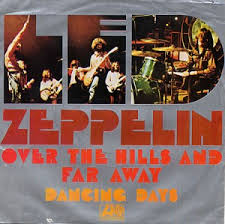
LED ZEPPELIN - OVER THE HILLS AND FAR AWAY

"I live for my dream and a pocket full of Gold
.......Acapulco Gold"

The light and shade, whisper to a thunderstorm dictum ran deep with Led Zeppelin and Jimmy Page's vision of their dynamic. The first four LP's are full of examples of slick, precise and deft arrangements, where both power and sensitivity dovetail together seamlessly.

From Babe I'm Gonna Leave You to Ramble On, What Is And What Should Never Be to Gallows Pole, and of course the ultimate light and shade perfection of Stairway To Heaven, Led Zeppelin showed time and time again they were (and remain to this day) so far ahead of the rest. 

In keeping with the positive vibe of the Houses Of The Holy sessions that began in earnest in early April of '72, Jimmy unveiled a winding, seemingly meandering guitar introduction. A distant cousin of his White Summer phrasing and atmosphere, with ringing open strings and use of chiming Dsus4 variations on firstly one then a second acoustic guitar. You can almost hear the sunshine, feel that late spring warmth on your face. 

Although some of the songs were laid down at Stargroves, most of the songs on the finished LP were recorded at Olympic. Over The Hills was recorded on April 16th, as the 'guitar mix backing track' on the companion disc attests, or at least the backing track and some overdubs were. Like much of the album, further mixing was done from the end of June and well into July at Electric Ladyland Studios, New York. A reel dated July 12th shows mixes from that day with the track still under the working title 'Many, Many Times'.


It was recorded live instrumentally, and Jimmy recalls playing it 'all the way through' on electric, later replacing the intro acoustically. As was Led Zeppelin's way it came together quickly, professionally, wonderfully.

From the assorted if fragmentary demo recordings we have, from both the innocent Bron-Yr-Aur baby steps to the compilation cassettes from Headley Grange and Plumpton, we know Jimmy had many ideas, riffs and phrases.  Indeed, songs covering the entire Zeppelin catalogue have some roots and seeds from those 1970 to 1971 sketches.

Over Jimmy's introduction Robert adds a positive if plaintive lyric, searching for love and the good things. Masterfully overdubbed chiming acoustic guitars build the momentum and stir the soul, then Led Zeppelin crunch down. Over the wonderful taut syncopation Robert rises an octave and takes things into the ether.


Lyrically, there is a Tolkien influence in there, from The Hobbit to a 1915 poem by JRR entitled 'Over Old Hills And Far Away'. It's also an old English saying, and am 18th century song that appears in The Beggars Opera. Robert's usual melting pot of lyrics. Of course, live we get the now famous 'Acapulco Gold' ad lib, a nod to the high grade cannabis that would waft onto the stage from various sections of the crowd nightly....


His lyrics begin with 'Many' for the first verses, echoing the working title 'Many Many Times' as shown on the original 'rough mixes' reel tape box. Once again the solo is perfect and unusual. Starting low and with a virtual symphony of guitars underpinning it, it's lyrical and thoughtful. The coda of the section features a brilliant ascending/descending scale from Jimmy and Jonesy as Bonzo strides through in 4/4 and they all meet on cue, perfectly at the end, just like Black Dog. 

After the final verse it winds down to a fade, Jimmy using the sitar like effect of playing on the 6 string of the double neck while the 12 string neck rings in empathy to create a gentle, winsome sound. A few synth notes from Jonesy pull the song back up to an actual end. In truth it's a brilliant song, one of my favourites and will always remind me of summer, positive things and good times.

And in true Zeppelin fashion, the studio version is only the beginning of the story. The live arrangement was set to be similar to the recorded version, extending as was their way during the solo break. Immigrant Song was reaching the end of it's time as a live number and would cease to open shows at the end of the '72 Summer Tour. 

The extended, winding solo, full of assorted rhythm and 60's references thrown in at Jimmy's whim would soon fit into Over The Hills as he duelled with Bonzo while Jonesy provided that unique, brilliant undercurrent. His work on this live shows his ability to do what few bassists can - be percussive and almost metronomic and lyrical and melodic at the same time. Two roles effortlessly rolled together and played as one.

Led Zeppelin were so enthused by their new songs they couldn't wait for the release of the LP to play them live. Indeed Dancing Days had already made a live appearance back in November '71 at Wembley. From the start of the 1972 North American Tour only teased hints of The Crunge and Walter's Walk in the post bow funk section of Dazed And Confused, but as they neared the west coast it all changed. A remarkable show at Seattle on June 19th featured (at least) 4 songs from the sessions, and Over The Hills, though edited on the audience tape was the 4th encore that night.

Come California, and the two shows used for How The West Was Won feature OTH as 3rd track (and again in Tuscon on the 28th by the way) and the version we have officially released is stunning. Short, taut and with Robert in his high voiced glory. 

From then on it was in the set. From the first show in Japan on October 2nd it followed the opening salvo (except Kyoto on October 10th where it was inexplicably played between Stairway and Whole Lotta Love!), and stayed there right through the following UK and European dates.

Come the 9th North American Tour it was always after the 3 song start and was beginning to stretch and groove all the more. Even if Robert couldn't hit the high register of the Houses sessions, the band were more than able to power and groove the song into something special. 

1975 and it was still in place and getting longer. Even on off nights it shone. In Montreal on Feb 6th Robert's voice was in poor shape and Jimmy had a guitar malfunction leaving the rhythm section to rearrange the piece with aplomb, improvising some mighty funk grooves until Jimmy roars back. The essence of live music. 

In 1977 it disappeared for the first leg of the tour, only to pop up again on Broadway at the 3rd Madison Square Garden show on June 10th, replacing In My Time Of Dying. 

They alternated from that point on, played 9 more times we have on tape against 4 more for In My Time. Again, it was longer and a solo showcase now. Check out the Listen To This Eddie night for that Page-Bonham duel! 

Finally, 1979 was it's finale, and once again Jimmy centrepiece with tortured solo's bathed in echo and staccato figures. the last live Led Zeppelin performance was at the 2nd Knebworth show on August 11th and ended with a broken string and flawed coda!

In 1980 it was gone, part of the cull of longer more indulgent live songs, a beautiful and pastoral Rain Song replacing it as the first major mood change in the set.

Aside from the two studio versions on the Houses box set, we have official live versions from the Song Remains The Same remastered version - plus the great footage on the extra disc - and on How The West Was Won. 

As far as filmed versions, we have a brief clip of 8mm cine film from Lyons on March 26th '73. On the North American Tour it appears on the Bonzo's Birthday Party 8mm clips and the home movie outtakes from the first two Madison Square Garden shows.

In 1975 there were more people filming from the audience, so we have clips from Madison Square on Feb 7th (this is from the photographer's pit in front of the stage and has been attributed to a few different shows), Philadelphia Feb 8th, Dallas March 4th and at least two of the LA Forum shows. All the Earls' Court shows were captured professionally and we have near perfect film of the 24th & 25th performances.

1977 sees two of the LA shows - June 22nd & 27th - plus the pro shot Seattle July 17th. In 1979 we of course have the two Knebworth pro shot recordings.

Post zeppelin there have been a few live attempts, but Jimmy's Outrider shows stand out, giving him the chance to loosen his fingers and create that cloud of dissonance.

And it was (very) occasionally played live by Page & Plant too...


And the last version was at the Cafe De Paris on December 7th 1997, which we also have film of to enjoy!

It was a single across many countries, coupled with Dancing Days and The Ocean on at least one occasion. In 1990 it was a promo CD for the Box Set and a promo video was made, featuring Earls Court and Seattle footage over the studio version.

A fantastic song, truly the essence of Led Zeppelin. A mixture of influences and styles and live a different animal again. Wonderful.


Sunday, 3 September 2017

LED ZEPPELIN - NO QUARTER

"They choose the path where no one goes..."


If ever there was a song that confirmed the ever onward, no boundaries evolution of Led Zeppelin, that song is No Quarter. Simply put, there's nothing like it. It's a unique animal, and the bridge between the seismic Rock and 'live' sounding splendour of much of the first albums and the searching progressive intoxications of future compositions, from In The Light to Kashmir, Fool In The Rain to Carouselambra. 

Although it fits perfectly as the penultimate track on Houses Of The Holy, taken in isolation it's the one song on the album that veers away from the positive, summer vibe of the sessions. And it's not just the mood of the song that does that. Jimmy's production is unique, almost revolutionary. Unlike the live, open crunch of The Ocean and the widescreen guitar army fanfare celebration of The Song Remains The Same, No Quarter is closed, tight and even sinister. 

It feels very much in your face, in your mind. The shimmering, underwater keyboard motif starts the mood, and when Bonzo and Jimmy enter in becomes even more claustrophobic. Heavily compressed, Bonzo punctuates right on the money and Jimmy is minimalist with mantric fuzztones underlying the riff.

When Robert enters it's even more startling. He's whispering into our ear, it's compressed, phased and sped up. Unsettling and unnerving, JUST what Jimmy was looking for. And the lyrics, just like the music, stick out against the positivity of the album. Devils mocking, side by side with death, steel that's bright and true. One of Robert's best set of lyrics for me. 

It's really mesmeric, out there. The solo mid section shocks again, with light, jazzy touches from Jimmy with a pure, clean tone as layered harmony fuzztones complement from afar. The return to the main theme and the long, swirling coda open the song and band up, after the subtle Theremin punctuation and confusing, almost cluttered vocal nuances and moans. 

It proves more than any song up to this point that any barriers, restrictions were smashed and Led Zeppelin could do whatever they felt. The World was indeed theirs. What misery with No Quarter?! To see how they came to this brilliant musical statement, this unique hybrid, you have to go back to the end of the 'II' tour dates and the preparation of 'III' and new music.

In October 1970 Led Zeppelin reconvened to begin working on new songs. They chose to return to Headley Grange, where some 6 months previously they'd crafted and readied the wonderful wide ranging material for 'III'.

Some of the new material came quickly, easily. Four Sticks was recorded in Island Studios in early November, Black Dog and Stairway a month later along with an early arrangement of Levee. The remarkable rehearsal recordings that came from Jimmy's own aural sketchbook archive highlight the positive vibe - you can see it so clearly on the fantastic cine film clips too - and let us hear a confident and refreshed Led Zeppelin. 

Among the recordings is a startling new direction. After initially embellishing and adding texture on You Shook Me and Your Time Is Gonna Come, Jonesy spread his influence further on Thank You, to the point that when it was added to the live set in January 1970 when he was afforded a solo introduction. This evolved from brief and pastoral to something of a Hammond Organ extravaganza by the time the 6th US Tour climaxed in New York on September 19th.

You can hear Jonesy's keyboard beautifully interacting with Jimmy's lyrical themes on the rehearsal arranging of Stairway and it sounds as if Jonesy siezed the moment to bring the shimmering, jazzy motif of No Quarter to the table. 

This embryonic kernel is faster than it would later evolve, with rimshot punctuation from Bonzo and a lyric free melody cue from Robert. Jimmy is busy throughout, mirroring Jonesy's Fender Rhodes riff, far from the minimalistic fuzztones on the recorded version, and the riff is not quite complete, the band pausing for Bonzo to syncopate and punctuate. We even get a clear as glass solo from Jimmy before the recording and adventure falls away.

The 1971 Led Zeppelin was a confident and brash animal. Their live show had never been better, stronger or more diverse. John Paul's keyboard contribution onstage was still confined to Since I've Been Loving You, Stairway and Thank You, now an encore with an even more elongated and delightful solo introduction by 'The man from Casablanca' as Robert later quipped. 

As 1971 moved into December they were nearing the conclusion of an intense and outstanding UK Tour. On the 2nd they played a remarkable show at Starkers Ballroom, Bournemouth on the south coast. The next day they were in Island Studios (no. 2) where at least 3 takes of No Quarter were recorded. All are instrumental, and include the version that would finally appear on Houses Of The Holy.

We have these 3 outtakes because a box full of master tapes were discovered in the loft of Plumpton Place, years after Jimmy had moved, and found their way into the hands of the man behind Bootleg CD 'label' Scorpio. there were four 2" master reels and four 1/4" tapes, that formed the backbone of Boot CD's Studio Daze, Jennings Farm Blues and One More Daze.  

Further mixing was done the following summer of those three takes, at Electric Ladyland Studios in New York.

In 1972 their adventure continued, Jonesy's influence growing all the time. The new material for Houses Of The Holy added more keyboard textures and harmonies than before as Led Zeppelin began to realize there were no boundaries, no limits, no pigeonholes, no quarter. 

The 2nd Japanese Tour in October 1972 added The Rain Song to the live set, giving Jonesy a chance to shine, even if the dreaded Mellotron wasn't always the perfect tool for the job. His solo and Thank You were becoming less frequent now, and the last live performance we have is at Southampton University on January 22nd 1973. But by the time Led Zeppelin began rehearsing and planning their 9th North American Tour in April 1973, No Quarter seemed an obvious live number, a brilliant mutation and platform for mood and colour.

From the start of that tour No Quarter would become a set staple. It began tentatively, nervously. Performed at all 34 shows, the earliest we have is the 2nd gig, the record breaking Tampa Stadium show. Some nights it seems a bit out of place, almost as if they're not sure, but within a few shows the new direction and the balance of the set become more and more comfortable. By the time the July dates head for New York and the 'film sharks' are around it's a revelation.

The version featured in the movie and soundtrack, despite the editing, is nigh on perfect. It's the July 28th show at Madison Square Garden, and highlights the confidence and musical interaction and brilliance of Led Zeppelin at this point. Jonesy's 'fantasy sequence' from the movie is perfect. Understated, dark and tongue in cheek. And the music is phenomenal.

1975, and Led Zeppelin were itching to start again. To reconquer the musical World they'd blitzed over 5 years. 18 months off the road was too long, and the new set was heavily focused on the riff based, groinal charge of the new material from Physical Graffiti. Jonesy was more than ever in the spotlight. for the 2nd part of the tour he had a grand piano as part of his live set up, and No Quarter would be introduced at the end of the first hour of the set as a showcase to him and a different, more thoughtful and possibly more inspirational piece than Dazed And Confused, now almost struggling to cope under its' own weight. 

Once again, it was played at all of the shows, even if we only have 31 recordings of the 34 played featuring it. The arrangement was now more sophisticated. Theremin blats and sirens filled the halls as Jonesy moved from electric to grand piano (from the start of the 2nd leg), and from there he set the tone of the song, the improvisation, the journey. 

Early shows pegged it at 15 minutes, but by the time we reached the tour climax in LA it was double the length and inspiration. 

Nassau on Feb 14 is stunning, St Louis 2 nights later too. As the tour rolls into march and towards the West Coast it extends and twists, with so many magic moments and interludes. The Earls' Court performances are a watershed, especially for UK fans. The May 24th performance stands up as on of THE great improvisations in Led Zeppelin's history. Jimmy once commented, when pressed about the fabled 'chronological live LP' that there was a version of this from EC that was a 'winning version'. I remember it so well from the 'Earls Court I' boot LP and decades later the footage...

Thanks to Jimmy's expanded reissue series we have the remarkable and bizarrely named '10 Ribs & All/Carrot Pod Pod'. Even more strikingly different to the rest of the Presence sessions than No Quarter was to Houses. It's a beautiful piece, a direct cousin of the live No Quarter mood and structure from the previous tour, but more relaxed and thoughtful, almost a film soundscape.

The 1977 shows leaned heavily on it for the improvisational aspect of the band. Jimmy wasn't Dazed And Confused any more. Again, of the 44 performed shows it was a constant except the aborted Chicago and Tampa gigs. An extra improvisation was added before the normal band entrance, and it could be boogie, strident rock or jazz. As with all improvisations, some nights it was perfunctory and others inspired. It was finally the main source of inspiration and diversity during the show. 


As short as 15 minutes, up to nearly 40 during the most indulgent shows. Jonesy was spreading his musical wings, quoting everything from Mary Poppins to Maurice Ravel via B Bumble and The Stingers on any given night. The famous 'Battle Scene' Destroyer 4LP set from Cleveland on April 28th was the first time we heard Nutrocker obliterated by Bonzo's sheer power.


 The level of sophistication was high, the 3 instrumentalists almost telepathically knowing what to do, how to weave, to ebb and flow, when to lead and when to augment. The perfect group. Free from any constraints, it truly was a blank canvas. The legendary 'For Badgeholders Only II' bootleg features possibly the finest version of all, a fantastic open audience recording and a unique, startling 3 way improvisation. 

It became the highlight of the show for me, the 'go to' track. Even when not inspired, there was - as with Dazed And Confused in the past - always something to inspire and surprise. 

When Led Zeppelin returned two years later they were wiser and slightly leaner. The excess of the final US Tour had been curbed a little, yet solo spots remained. No Quarter was cut back, the opening riffs cut so the vocals started almost immediately, and the 4 versions performed in 1979 are somewhat shy and nervous. Only at the 3rd of those - the August 4th Knebworth comeback - does the coda extend and threaten to revive those telepathic moments of yore. 

After the August 11th show it was gone as Led Zeppelin attempted renewal with a hard, stripped down set. Laura Ashley blouses were now Brazil football shirts, suits were off the peg and hair was shorter. No Quarter had been the source of live inspiration for Led Zeppelin from certainly 1975, but now it was time to move on. Who could foretell what would have been next?

On film, we have those pro shot shows - The Movie, 2 Earls' Court nights, Seattle '77 and the 2 Knebworth shows. Audience cine film is harder, the length of reels leaving us with some edits, moments. It is included in the LA Forum May 31st '73 Black & White clips and at Kezar two days later. 


There's a brief but close edit from the Chicago January 22nd '75 cine bootleg, similarly Dallas March 4th, Seattle on the 17th & 21st and at least 2 of the 3 LA Forum shows that closed the tour. Short clips continue in 1977 with the final 2 shows in Chicago on April 9th & 10th, New York June 10th and the final LA June 27th show.

Post Zeppelin, the most contentious reworking was for the Unledded project. Politics and the rest aside, Jimmy's shimmering, razor edged 12 string treatment worked for me, and there were some stunning live versions throughout the tour for sure. 

In 1998 it reverted to the 1973 arrangement, and a perfect excuse for Jimmy to solo, show he still had it. Robert has dabbled with arrangements over the years, and Jonesy too performed it.

And of course we have the ultimate tribute with the O2 (and rehearsal) versions, again based on the '73 succinct arrangement. 

However good, different and fine the post Zeppelin versions are, they lack the telepathy, the nuances and the unbelievable musical understanding that made the song and indeed made Led Zeppelin unique. Have a listen to any of the versions here, and you'll know....